Skip to content
If you have ever searched for “digital marketing agency near me” and landed on a page with a small “Ad” label next to it, you have already seen ads pay per click in action. For business owners across Northern Ireland and the Republic of Ireland, understanding the different types of ads pay per click is often the first real step toward spending marketing budget with confidence instead of guesswork.
This guide breaks down the three platforms that matter most for Irish and NI businesses right now. We will look at how major ads pay per click actually works behind the scenes, what makes Google, Meta and LinkedIn different from each other, and where beginners usually go wrong. By the end, you should be able to look at your own business and know which type of ppc ads is worth testing first.
Key Takeaways
- Ads pay per click only charges you for genuine engagement, not simple visibility, which makes relevance more valuable than raw budget size.
- Google, Meta and LinkedIn serve different moments in the customer journey, so the “best” platform depends on your product and your customer, not on trends.
- Quality Score rewards businesses that align keywords, ad copy and landing pages closely, often lowering costs more than a bigger budget ever could.
- Cross-border NI and RoI businesses need separate thinking for currency, language and search intent, not one blended campaign.
- Most beginner mistakes come from impatience, not poor strategy, since platforms need time and data before they perform well.
- The right choice between DIY and an agency .
How Ads Pay Per Click Advertising Works
At its simplest, ads pay per click means you only pay when someone clicks your advert. You are not paying for space on a page the way you would with a billboard or a newspaper spot. You are paying for action, which is exactly why this model has become the default for advertising pay per click across almost every industry.
Behind every ad auction sits a bidding system. Advertisers set a maximum amount they are willing to pay per click, then the platform runs an automatic auction each time someone searches a term or scrolls past a placement. The winner is not always the highest bidder. Quality, relevance and expected click-through rate all factor into who actually gets shown.
This is where a lot of Irish business owners get caught out. They assume ppc ads work like a straight bidding war, so they either overspend to “win” or underbid and see nothing. In reality, a well-targeted, well-written ad can beat a bigger budget with a weaker one. That is the whole appeal of ads pay per click for smaller NI businesses competing against bigger regional players.
Google Ads
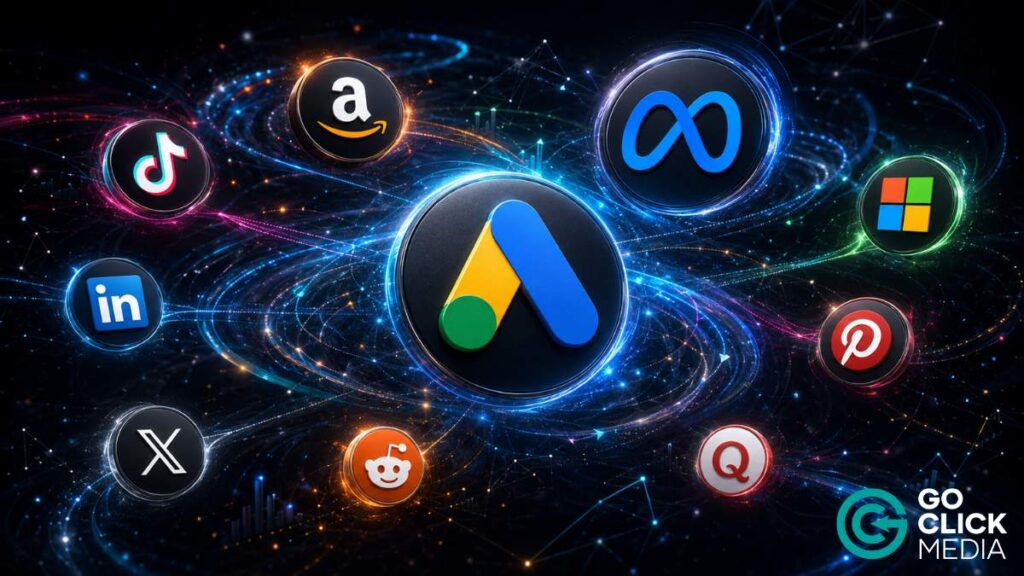
Google Ads is the platform most people picture when they hear ads pay per click. It covers search results, Shopping listings, YouTube, and the Display Network of partner websites and apps. For most Irish businesses, Search is where the real intent lives, since people are actively typing in what they want.
Ads Pay Per Click on Google Search
When someone in Belfast types “emergency plumber Lisburn” or someone in Dublin searches “google ads agency”, Google Search is where that moment gets captured. This is high-intent traffic. The person is not browsing, they are looking for a solution right now.
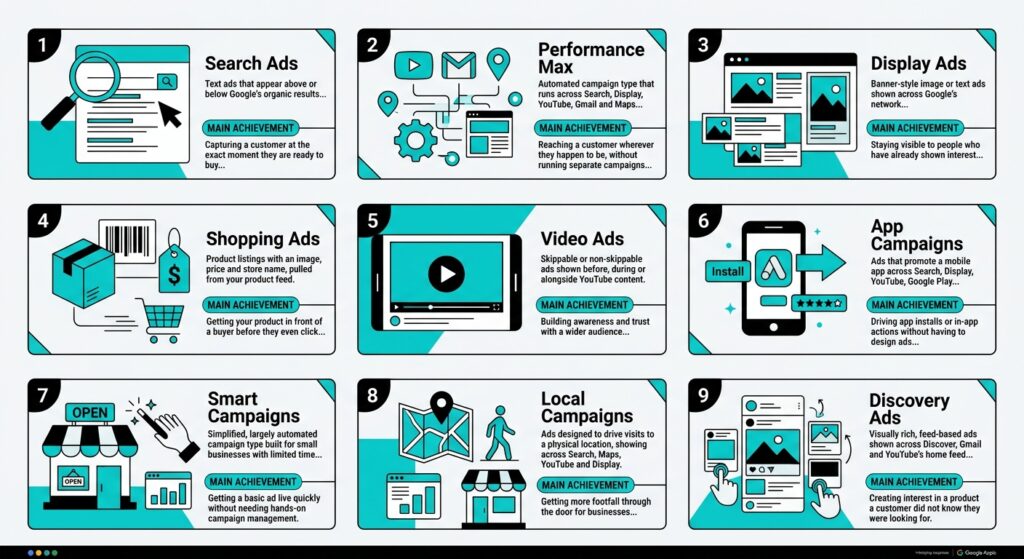
Search campaigns work on keywords and match types, so you are bidding to appear against specific phrases your customers actually use. Shopping campaigns work differently, pulling product data straight from your feed to show images and prices before a click even happens. Performance Max sits across both, letting Google’s automation decide where your budget goes.
The tradeoff with Google is cost. Competitive sectors like legal services, finance and home improvement carry some of the highest per click prices in the UK and Ireland market, so budget needs to match ambition here.
|
GoClick Media Pro Tip: Before you spend a single pound or euro on Google Ads, check your Google Business Profile is fully filled in and verified. A weak or unclaimed profile quietly drags down your Quality Score and your local ad relevance, even though it feels unrelated to the campaign itself. |
Types of Google Ads
Meta Ads
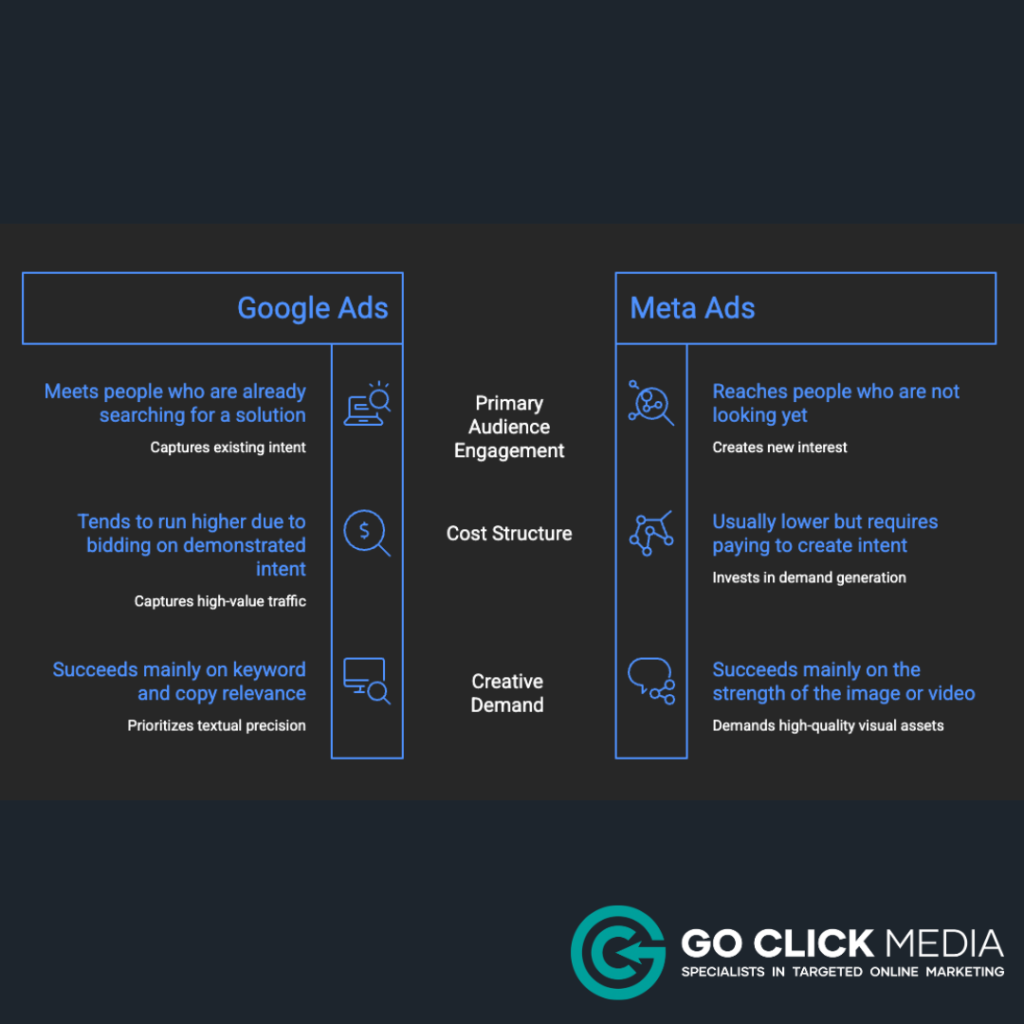
Meta Ads covers Facebook, Instagram, Messenger, Threads, and some extend to Whats app from one dashboard, and it remains the most commonly used platform among small and medium NI businesses. Where Google captures people actively searching, Meta reaches people scrolling, which makes it a demand-generation tool as much as a demand-capture one.
Meta’s targeting works on interests, behaviours, lookalike audiences built from your existing customers, and increasingly on Advantage+ automation that lets the algorithm find buyers for you. For a hospitality business in Fermanagh or a retailer in Newry, this often means cheaper reach and lower cost per click than Search, though the intent behind that click can be softer.
Creative matters more here than on any other platform. A static image with a discount code rarely performs the way a short video or a genuine customer photo does. This is also where ppc ads and organic social content start to blur, since the best-performing paid posts often look almost identical to organic ones.
Meta also works well for businesses without a large budget to test with. Because the platform can reach a wide audience cheaply, even £10 to £20 a day is often enough to start gathering useful data on what creative and audience actually convert, something Search rarely allows at that spend level.
Three major differences between Google Ads and Meta Ads
LinkedIn Ads
LinkedIn is the outlier of the three. It is built for business-to-business targeting (B2B), letting advertisers reach people by job title, company size, industry and seniority rather than personal interests. For NI’s agri-food exporters, professional services firms and growing tech sector, that precision is hard to replicate anywhere else.
The catch is volume. LinkedIn’s audience in Northern Ireland is smaller than Meta’s or Google’s, so campaigns typically need longer to gather enough data before results stabilise. This is not a platform for a business wanting fast, high-volume wins. It is a platform for a business chasing fewer, higher-value conversations.
|
GoClick Media Pro Tip: LinkedIn’s cost per click will almost always look expensive next to Meta or Google. Compare cost per qualified lead instead, not cost per click, because one properly targeted decision-maker is often worth ten irrelevant clicks from a cheaper platform. |
Unique Advantages and Disadvantages of Each Platform
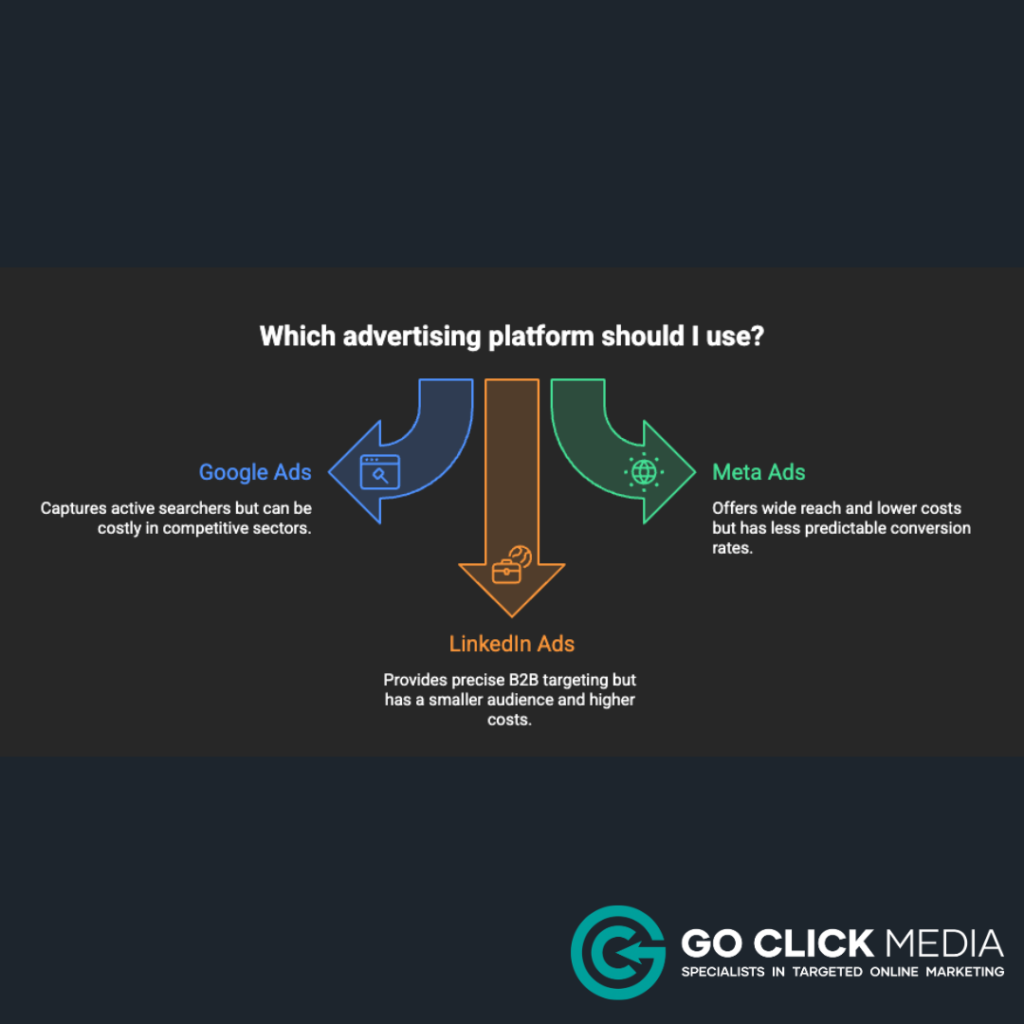
Putting the three platforms side by side makes the decision easier for a first-time advertiser.
- Google Ads advantage: captures people already looking for what you sell
- Google Ads disadvantage: can carry a high cost per click in competitive sectors
- Meta Ads advantage: strong reach and lower typical cost per click across NI and RoI
- Meta Ads disadvantage: intent is softer, so conversion rates can be less predictable
- LinkedIn Ads advantage: unmatched precision for B2B targeting by role and industry
- LinkedIn Ads disadvantage: smaller audience and higher cost per click than the other two
No single platform is universally “best.” The right mix of ads pay per click depends on whether your customer is actively searching, casually scrolling, or making a considered business decision.
Setting a Realistic Budget
Most NI small businesses start paid media somewhere between £500 and £2,000 a month, with the smallest campaigns starting closer to £300. Larger e-commerce and lead-generation accounts commonly run £5,000 to £50,000 or more, depending on ambition and competition.
Cross-border businesses trading into the Republic of Ireland also need to plan for two currencies and slightly different search behaviour between .co.uk and .ie audiences. A single “UK-wide” campaign often wastes budget here, because it treats two different markets as one.
|
GoClick Media Pro Tip: Work backwards from your target number of leads or sales, not forwards from a spare marketing budget. If you need 20 leads a month and your realistic cost per lead sits around £70, your starting budget should be built around that maths, not around what feels comfortable to spend. |
Understanding Quality Score
Quality Score is Google’s rating of how relevant your ad, keyword and landing page are to the person searching. It is scored from one to ten, and it directly affects both your ad position and how much you pay per click.
Why Quality Score Affects Your Ads Pay Per Click Costs
Three things drive Quality Score. Expected click-through rate, ad relevance, and landing page experience. A business with a high score can pay less per click than a competitor with a lower score, even in the same auction. This is the clearest proof that ads pay per click rewards relevance over raw budget.
Improving Quality Score is usually a matter of tightening the connection between your keyword, your ad copy, and the page someone lands on. A generic homepage sent to every keyword almost always scores worse than a dedicated page built around one specific offer.
Common Beginner Mistakes
Most first-time PPC accounts in Northern Ireland run into the same handful of problems.
- Turning campaigns on and off too quickly, before the platform has enough data to learn
- Sending every click to a homepage instead of a page built for that specific offer
- Ignoring negative keywords, so budget gets wasted on irrelevant searches
- Setting a budget too small for the platform’s own learning requirements
- Never checking which keywords or audiences actually produced a sale
- Getting conversion tagging wrong, whether that’s missing tags, duplicate tags, or tags firing on the wrong event.
Correct technical implementation is what makes every other decision on this list possible, since a platform can’t optimise toward data it’s not receiving properly
Most of these mistakes come from treating ads pay per click as a “set and forget” tool rather than something that needs regular attention in the first few weeks.
When to Hire an Agency vs DIY
DIY makes sense when budgets are small, the business owner has time to learn the platform, and the offer is simple enough that one landing page covers most searches. Many NI micro-businesses start here, and that is a sensible way to learn the basics of ppc ads without a large commitment.
An agency earns its fee once the account gets more complex. That usually means multiple platforms running at once, cross-border NI and RoI targeting, or a budget large enough that mistakes become expensive. At that point, the time saved and the errors avoided are usually worth more than the management fee itself.
Conclusion
Every platform covered here shares the same underlying idea. Ads pay per click rewards businesses that understand their customer and match that understanding with the right platform, the right budget and the right landing page. Google captures intent, Meta builds reach, and LinkedIn opens doors that neither of the other two can reach on its own.
Getting the mix right takes a bit of trial, a fair amount of data, and enough patience to let each platform do what it does best. If you would rather skip the learning curve and start with a strategy built around your specific market, GoClick Media works with NI and cross-border businesses every week to plan, launch and manage exactly this kind of campaign. Get in touch with GoClick Media for a free consultation and we will help you work out which type of ads pay per click makes the most sense for your business right now.
What does “pay per click” actually mean in practice?
It means you are billed only when someone clicks your advert, not simply for it being displayed. This makes ads pay per click a performance-based model rather than a flat media buy.
Which platform should a first-time advertiser in NI start with?
It depends on your customer. A business with clear buyer intent, like a tradesperson or a solicitor, often starts with Google Ads. A business selling visually, like retail or hospitality, often gets more from Meta first.
Is a higher budget always the answer to poor results?
No. A low Quality Score or weak targeting will waste a bigger budget just as easily as a small one. Fixing relevance usually delivers a better return than simply spending more.
How long before ads pay per click campaigns start performing well?
Most platforms need several weeks of consistent activity before their bidding systems have enough data to optimise properly. Judging a campaign in the first few days is one of the most common beginner mistakes.
Do NI businesses need to treat the Republic of Ireland as a separate market?
Generally yes, particularly around currency, delivery terms and search behaviour differences between .co.uk and .ie audiences. Blended UK-wide campaigns often underperform compared with ones built with cross-border nuance in mind.
Can a small NI business realistically compete with bigger UK advertisers?
Yes, because Quality Score and relevance matter more than budget size in most auctions. Local knowledge, faster relevance and tighter targeting often let a smaller business win valuable clicks at a lower cost.
When is it worth bringing in an agency instead of running campaigns in-house?
Yes, in most cases, if you’re serious about growth. The industry moves fast, and real expertise makes a big difference to results. Setting aside a marketing budget for agency support is what keeps you from falling behind while you focus on running the business.